Home » David Cronenberg
Not a bad year for horror films. These are in no particular order, apart from Frankenstein, It’s in a league of its own. Nothing came close to it in 2025. Yes, it’s that good! A masterwork.
| Frankenstein | The Monkey |
| Weapons | 28 Years Later |
| Presence | The Shrouds |
| Dangerous Animals | Bugonia |
| Forgive Us All | Opus |
Frankenstein 

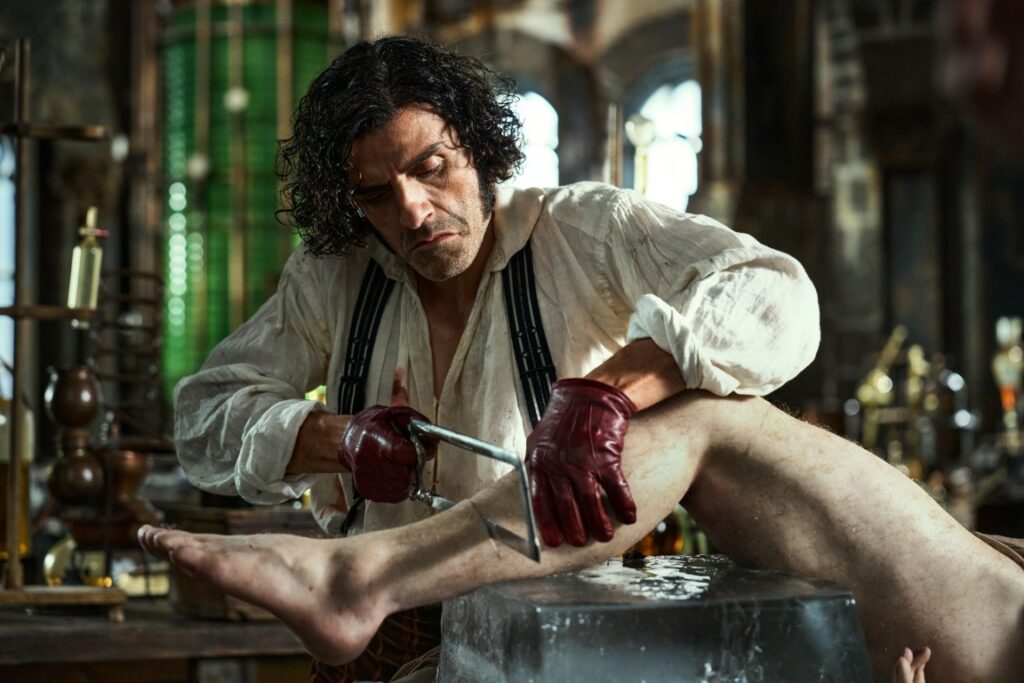
Guillermo del Toro’s Frankenstein (2025) is a visually stunning and emotionally resonant reimagining of Mary Shelley’s classic tale. Del Toro blends his signature gothic aesthetic with a deeply humanist approach, crafting a world that is as grotesque as it is beautiful. The film’s monster, brought to life with a combination of practical effects and subtle CGI, is both terrifying and sympathetic, embodying the anguish of isolation and the longing for acceptance. The narrative delves beyond the familiar horror tropes, exploring themes of creation, responsibility, and the blurred line between humanity and monstrosity. Performances are compelling across the board, particularly from the leads, whose chemistry adds depth to the philosophical underpinnings of the story. The cinematography and production design immerse viewers in a richly textured, hauntingly atmospheric setting, while Alexandre Desplat’s score underscores the tragic grandeur of the tale. Frankenstein succeeds not only as a horror film but as a profound meditation on empathy, identity, and the consequences of playing god, cementing del Toro’s status as a master of modern gothic cinema.
The Monkey 

Osgood Perkins, the filmmaker behind The Blackcoat’s Daughter and Longlegs, takes a sharp left turn with his latest adaptation of Stephen King’s short story, The Monkey. Where one might expect a grim and oppressive descent into supernatural dread, Perkins delivers something stranger: a grisly, absurdist horror-comedy that mixes slapstick energy with unnerving gore.
At its center is Theo James, pulling double duty as estranged twin brothers haunted since childhood by a demonic toy monkey whose clashing cymbals seem to signal death. James’ performances give the film an anchor—one brother weary and bitter, the other fragile and guilt-ridden. Surrounding him is a strong cast including Tatiana Maslany, Elijah Wood, and Adam Scott, all leaning into the film’s tonal weirdness with varying degrees of success.
What makes The Monkey memorable is its willingness to lean into outrageousness. Perkins stages death scenes like punchlines—grisly Rube Goldberg spectacles that leave the audience unsure whether to laugh, wince, or both. The editing is tight (at under 100 minutes, it never drags), and the film often looks stunning, shot with the icy precision that has become Perkins’ trademark.
But this very precision creates a divide. The film’s cool, calculated visual style often feels at odds with the anarchic humor, producing a tonal clash that some will find exhilarating and others jarring. Characters are painted in broad strokes, and beyond the monkey’s cruel game of fate, there isn’t much thematic depth. For viewers seeking a more layered King adaptation, this may feel thin.
Still, there’s no denying The Monkey is entertaining in its audacity. It’s gory, funny, and unapologetically strange—a film that knows exactly what it is and doesn’t care if you’re on board or not. Like the cursed toy at its heart, it clangs its symbols loudly, daring you to laugh even as it ushers in another grotesque demise.
A polarizing but bold horror-comedy—part midnight-movie romp, part stylish nightmare. Not for everyone, but for those with a taste for the gleefully grotesque, The Monkey will hit all the right notes.
Weapons 

After the breakout success of Barbarian, director Zach Cregger returns with Weapons, a bold and unsettling horror epic that confirms his status as one of the most inventive voices in the genre. Instead of a straightforward narrative, Cregger structures the film as a series of interwoven character perspectives, all orbiting around the mysterious disappearance of a classroom of children at exactly 2:17 a.m. The result is part mystery, part social satire, and part folklore-tinged nightmare.
The cast is superb. Julia Garner lends quiet strength as a teacher grappling with guilt, Josh Brolin delivers raw intensity as a grieving father, and Amy Madigan dominates every scene as Gladys, a chilling antagonist whose dark rituals give the film its folkloric edge. Supporting turns from Alden Ehrenreich and Benedict Wong add texture to the web of paranoia and suspicion.
Visually, Weapons is striking. Cinematographer Larkin Seiple crafts dimly lit, atmospheric frames that heighten both dread and intimacy. The pacing is deliberate—sometimes almost meditative—but every scene carries a sense of creeping inevitability, rewarding patient viewers with moments of shocking clarity.
While some may find its fractured structure and slow burn frustrating, Weapons thrives on ambiguity and atmosphere. It’s less about jump scares than the unnerving ways violence, grief, and superstition intersect. By the final act, Cregger ties the threads into a conclusion that feels both inevitable and deeply unsettling.
Disturbing, ambitious, and impeccably acted, Weapons is one of the standout horror films of 2025—a genre experiment that lingers long after the credits roll.
28 Years Later 

Danny Boyle and Alex Garland reunite nearly three decades after 28 Days Later to deliver a sequel that feels both familiar and daringly new. Set largely on Lindisfarne Island, the film contrasts sweeping pastoral imagery with visceral terror, all heightened by Boyle’s decision to shoot much of it on iPhones. The result is an unsettling blend of natural beauty and raw immediacy.
At its heart is Spike, a 12-year-old boy whose journey into chaos and loss forms the film’s emotional backbone. Alfie Williams gives a remarkable performance—fragile yet resilient—making his arc one of the most affecting in the franchise. Jodie Comer adds gravitas and vulnerability as Isla, while Ralph Fiennes, in a quieter turn as Dr. Kelson, infuses the story with philosophical weight.
The infected have evolved in startling ways, no longer just mindless threats but symbols of cultural isolation and societal fracture. These innovations, paired with a haunting score by Young Fathers, keep the horror fresh while grounding it in allegory.
That said, the film occasionally falters with uneven pacing and tonal shifts, at times prioritizing atmosphere over momentum. The bold finale, designed to tee up a new trilogy, feels abrupt—undercutting the emotional closure built throughout.
Even with its imperfections, 28 Years Later stands as a worthy and thought-provoking revival. It prioritizes emotion, artistry, and social commentary over simple gore, proving the series still has teeth—and plenty left to say.
Presence 

Steven Soderbergh quietly returns to form in Presence, crafting a ghost story that’s more elegy than scare ride. Entirely seen through the camera’s vantage—representing the ghost—this film reframes the haunted-house genre into a deeply emotional drama. Its strength lies not in shocks, but in lingering, melancholic tension.
The Payne family—led by Lucy Liu’s driven Rebecca, Chris Sullivan’s gentle but distant father, an ambitious son, and a grief-shrouded daughter, Chloe (Callina Liang)—inhabits a sprawling house under the watchful lens of its unseen occupant. Chloe, mourning a lost friend, senses more than the others, cultivating a fragile bond with the presence that feels protective rather than sinister.
Soderbergh’s camera is the film’s emotional core: gliding through halls, pausing in corners, watching with empathy. The subtle, quiet dread it cultivates is often compelling, though the film occasionally drifts, revealing narrative threads that seem underdeveloped. Yet, what it lacks in plot tightness it makes up for in tone and atmosphere.
Performances are understated but effective—Liang’s Chloe is quietly compelling, while Liu and Sullivan bring the sharp edges of familial strain into view. Despite minimalist dialogue, the emotional stakes feel real.
The conclusion delivers a shift that’s both tender and haunting, reframing everything that came before. It’s a twist that isn’t flashy but deeply affecting—one of those moments that lingers long after the credits roll.
Presence isn’t a horror movie in the traditional sense—it’s a poetic study of grief, family, and the unseen ties that bind us, told through the melancholy gaze of someone who’s already gone. It may unsettle you quietly rather than scare you outright—and it’s all the more memorable for it.
The Shrouds 

David Cronenberg’s The Shrouds is a haunting and divisive exploration of grief, technology, and the strange ways we try to hold onto the dead. Vincent Cassel stars as Karsh Relikh, a tech magnate who invents GraveTech, a system that lets mourners watch their loved ones decompose in real time through digital headstones. For Karsh, it’s a way to remain tethered to his late wife (Diane Kruger), but when the feeds are hacked and disturbing images appear, paranoia and conspiracy spill into his mourning.
As with much of Cronenberg’s work, the surface plot is less important than the atmosphere it creates. The production design is immaculate—bedrooms glow like laboratories, cemeteries are bathed in sterile light—and Howard Shore’s mournful score lingers like a ghost. Cassel delivers a deeply internal performance, his grief held in taut restraint, while Kruger doubles as both wife and her twin sister, blurring the line between memory and reality.
The film is deliberately cold and elliptical. Threads of corporate espionage and surveillance never resolve cleanly, which some viewers will find frustrating. Yet beneath its abstraction lies a deeply personal core, reflecting Cronenberg’s own experience of loss. The Shrouds is less about death than the inability to let go, and the futility of using technology to sanitize grief.
Beautiful, unsettling, and emotionally distant, The Shrouds may alienate audiences who want narrative closure. But for those attuned to Cronenberg’s late-career meditations, it stands as a chilling and poignant work—a requiem etched in glass and steel.
Dangerous Animals 

Dangerous Animals is a lean, blood-soaked thriller that gleefully blends shark-movie spectacle with serial-killer horror. Directed by Sean Byrne, the film follows Zephyr, a reckless surfer whose carefree lifestyle takes a terrifying turn when she’s abducted by Tucker, a deranged boat captain with a sinister obsession: sacrificing his victims to the ocean’s predators. What unfolds is a claustrophobic survival story that feels part Jaws, part The Silence of the Lambs, and entirely its own beast.
The film thrives on its two central performances. Hassie Harrison brings grit and vulnerability to Zephyr, making her more than just another final girl, while Jai Courtney chews the scenery as Tucker, balancing charm and menace in a way that makes him both magnetic and monstrous. Their cat-and-mouse dynamic drives the narrative with an uneasy tension that rarely lets up.
Byrne directs with tight control, resisting cheap jump scares in favor of sharp pacing and sudden, brutal bursts of violence. The sharks themselves are used sparingly, which only heightens their impact, turning them into an extension of Tucker’s madness rather than just digital monsters. While the story occasionally leans into familiar genre beats, the execution keeps it engaging, delivering enough surprises and grotesque thrills to satisfy horror fans.
Overall, Dangerous Animals may not reinvent the genre, but it’s a stylish, high-energy survival horror with teeth. It’s grisly, tense, and unapologetically pulpy—perfect fare for anyone craving a fresh spin on both shark films and serial-killer slashers.
Bugonia 

Bugonia is an unsettling, darkly comic psychological thriller that lingers long after the final frame, less because of what it shows than because of what it suggests. It is a film about belief—how it forms, how it metastasizes, and how easily it can turn ordinary people into agents of quiet horror. Rather than offering a traditional narrative arc, Bugonia unfolds like a tightening vice, slowly compressing the viewer into the same claustrophobic mental space as its characters.
The story begins with a premise that borders on the absurd, yet the film treats it with unwavering seriousness. This refusal to acknowledge its own strangeness becomes one of Bugonia’s most effective tools. Humor emerges not through punchlines, but through the uncomfortable recognition of how plausible irrational thinking can feel when framed as certainty. The film understands that conspiracy thinking does not begin in madness, but in fear, ego, and the seductive comfort of having secret knowledge.
The performances are central to the film’s success. The leads deliver restrained, deeply committed portrayals that avoid caricature at all costs. Their emotional flatness is not emptiness, but control—an unsettling calm that slowly erodes as obsession takes hold. Small gestures and tonal shifts signal enormous internal changes, making the characters’ psychological descent feel organic and disturbingly believable. No one in the film seeks audience sympathy, and that refusal makes the experience more bracing and honest.
Visually, Bugonia is precise and minimalist. The camera often maintains a detached, observational stance, framing characters in ways that emphasize isolation and rigidity. Clean lines, static compositions, and muted colors create a world that feels sterile and overly ordered, in sharp contrast to the irrational thinking driving the story forward. When the film disrupts this visual discipline, the impact is immediate, underscoring moments where belief overwhelms control.
The film’s pacing is deliberately measured, even repetitive, which will test some viewers’ patience. Scenes often linger longer than expected, conversations circle familiar ground, and progress feels incremental. Yet this repetition is purposeful: it mirrors the looping logic of obsession itself. The viewer is not meant to be entertained in a conventional sense, but immersed in a mindset where certainty replaces curiosity and doubt becomes an enemy.
Where Bugonia will most sharply divide audiences is in its conclusion. The film resists catharsis, closure, or moral hand-holding. Instead, it ends on a note that feels more philosophical than narrative, forcing the audience to confront the implications of what they have witnessed. This ambiguity may frustrate those seeking resolution, but it is entirely consistent with the film’s thematic core.
Ultimately, Bugonia is a cold, intelligent, and deeply unsettling film that prioritizes ideas over comfort. It is not designed to please, but to provoke—to sit in the uneasy space between satire and tragedy. For viewers willing to engage with its slow burn and moral discomfort, Bugonia offers a haunting reflection on paranoia, power, and the dangerous allure of believing you alone see the truth.
Forgive Us All 

Forgive Us All is a haunting exploration of faith, guilt, and redemption, set against a backdrop of intimate family drama and simmering tension. The film follows a fractured family grappling with buried secrets and moral compromises, weaving together themes of spirituality and human frailty with a measured, atmospheric approach. Its pacing is deliberate, allowing emotions to breathe, while the cinematography leans into shadow and silence, creating a sense of unease that lingers throughout.
The performances are the film’s strongest element—each actor brings layered vulnerability and quiet intensity, grounding the more abstract themes in raw human conflict. The script avoids heavy-handedness, instead favoring ambiguity and subtle revelations that leave viewers questioning where forgiveness begins and ends. While its slow-burn style may challenge audiences craving a more conventional dramatic arc, the film rewards patience with moments of piercing emotional resonance.
Ultimately, Forgive Us All is less about providing answers than about immersing viewers in a moral and emotional labyrinth. It’s a stark, contemplative work that resonates long after the credits roll, marking it as one of the more thought-provoking films of the year.
Opus

Mark Anthony Green’s Opus is a strikingly confident directorial debut, one that blends style and substance with an assured hand. The film is a layered meditation on ambition, artistry, and the costs of chasing greatness, told with a visual polish that feels both contemporary and timeless. Green crafts his story with precision, drawing audiences into a world where creative drive collides with personal vulnerability, raising questions about what it truly means to leave a legacy.
What makes Opus resonate is its balance of intimacy and spectacle. The narrative unfolds with deliberate pacing, allowing character moments to breathe while maintaining a steady undercurrent of tension. Performances are strong across the board, with the cast delivering work that feels lived-in and authentic, grounding the film’s thematic ambition in human emotion. Green’s direction is bold yet restrained, avoiding excess while leaning into the power of image, silence, and rhythm to carry meaning.
As a debut, Opus signals the arrival of a filmmaker with a clear voice and a sharp eye. It’s a film that is unafraid to confront big questions while staying anchored in personal stakes, leaving audiences with the sense that they’ve witnessed not only the story of its characters but the emergence of a major new talent.
Home » David Cronenberg
The enthusiasm for Crimes of the Future reveals that David Cronenberg still has a loyal following more than fifty years after he began making movies. However, a large portion of those of us who believe themselves to be among their fans never learned of his work in the theatre, much less at Cannes. Instead, we discovered it at the video store; ideally, one that dedicated an entire area to his work, or at the very least to his signature genre of “body horror,” which his films would have dominated in any case. Therefore, it is appropriate that the new Cronenberg interview below takes place among shelves that are crammed with DVDs and Blu-Rays, if not the VHS tapes and Laserdiscs we grew up with.
And here’s David in the Criterion Closet having more fun.
Home » David Cronenberg
Toronto is the horror capital of Canada!
It has hosted some the first and biggest zombie walks. Maybe that’s why George Romero made his last few films here and lived in Toronto up until is death. But is he really dead? Guillermo del Toro has made five films in Toronto and is currently working on his vision of Frankenstein. Toronto’s icy cold won’t stop this mad genius Mexican from loving this city. Toronto is also the birthplace of David Cronenberg. That alone should grant Toronto the horror capital of Canada. Did I mention there is Lucio Fulci movie marathon happening at our local community cinema (The Revue) as I type this post. Also, the home of the #1 and foremost horror culture magazine (sorry Fangoria), Rue Morgue Magazine.
Anyway, here’s a video of downtown Toronto scaries this past week. Much more to follow I imagine. I love this city but more during this time of year.
Home » David Cronenberg
Tickets purchased! I can’t wait to see what another Cronenberg offspring does. In this case Caillen Cronenberg‘s Humane. Brother Brandon has done some good films with Possessor and Infinity Pool. I’m so happy they both continue in genre films. Long live the new flesh!
Home » David Cronenberg

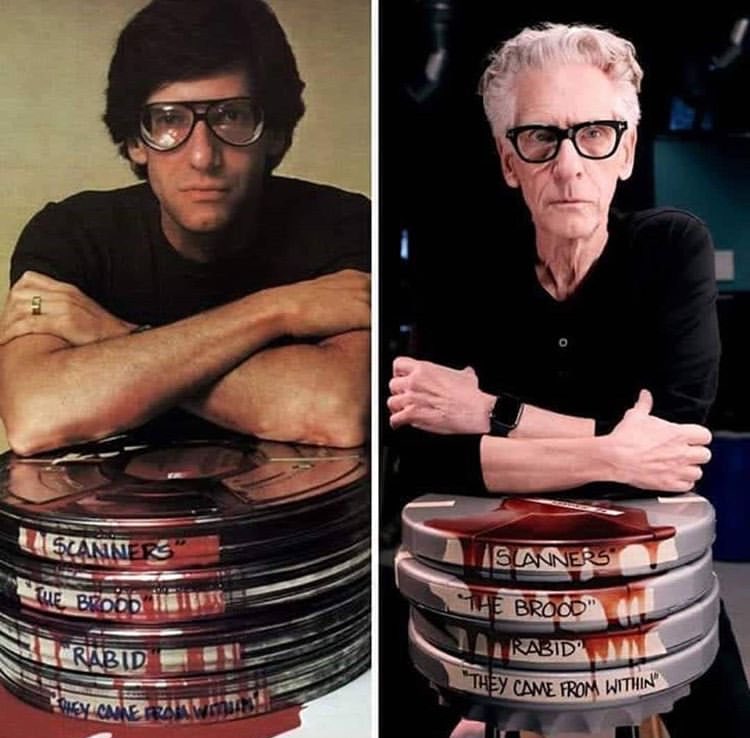
I decided to have a home film festival honoring the work of my hometown hero, David Cronenberg.
I was fortunate to meet David Cronenberg for lunch in my late teens. I was working at the Oakville Centre of the Performing Arts at the time and the girl who was teaching drama to the children there knew Cronenberg’s sister, Denise. I must have hounded her relentlessly, with me being a horror film genre nut and a Cronenberg super fan. I can’t remember exactly where his house was at the time, I think around Summerhill subway station. He made me a sandwich (tuna if I recall) and we spent an hour talking about old timey horror films, mostly German expressionist films like Nosferatru and The Cabinet of Dr. Caligari. To say I was in heaven was an understatement. He mentioned he was in the process of writing the screenplay for a film called The Fly but was struggling with not having it turn into just another monster film. I remember how encouraging he was about filmmaking. Told me not to give up. He was soft spoken, kind and very polite. Not at all what I was imagining on my walk to his house. When we parted he asked me to leave my phone number as he might have some extra work in his film. I can only assume it was The Fly. Sadly, the call never came but one of my best memories remain. It’s not often you meet your heroes and it’s certainly a bonus when they exceed all your expectations.
For shits and giggles I used some AI (ChatGPT) for all the film reviews below. Not bad, but not great. When I have more time I’ll go back, edit and make them more human than human.
Shivers (1975)

A classic in the genre of body horror that helped to define the auteur’s career. The story follows an isolated apartment building in Montreal where the residents are infected with a mysterious parasite that causes them to experience violent and sexual cravings. The doctor who created the parasite, Dr. Emil Hobbes, has also created a serum that can cure the infection, but it is stolen before it can be distributed. The film is a masterclass in suspense and horror, as Cronenberg builds tension in subtle ways to keep audiences on the edge of their seats. The special effects are also quite impressive, particularly the parasite itself, which has a unique look that makes it both creepy and fascinating. The acting is also great, with Paul Hampton as the doctor, Joe Silver as the landlord, and Lynn Lowry as the infected woman who becomes the parasite’s main victim. In the end, Shivers is a classic horror film that still holds up today. It is a dark, unsettling movie that is perfect for fans of the genre. Highly recommended.
Rabid (1977)

Rabid tells the story of a woman named Rose (Marilyn Chambers) who is involved in a motorcycle accident and undergoes experimental surgery. The surgery results in Rose developing a taste for human blood, which causes her to spread a mysterious disease that turns people into zombie-like creatures.
Cronenberg’s unique vision is on full display in Rabid, which explores the themes of disease, transformation, and societal breakdown. The film is a powerful commentary on the dangers of medical experimentation and the effects of the spread of disease. The movie is filled with unsettling, body horror imagery and graphic violence that would become the hallmark of Cronenberg’s later work.
The lead actress Marilyn Chambers delivers a strong performance, conveying both vulnerability and menace as her character goes through her transformation. The supporting cast is also strong, with solid performances from Frank Moore and Susan Roman.
Rabid is a thought-provoking and visually striking horror film that showcases Cronenberg’s mastery of the genre. While it may not be for everyone due to its graphic content, fans of the horror genre and fans of Cronenberg’s work will appreciate the film’s themes, unique style, and memorable imagery.
The Brood (1979)

This film follows a psychologist who becomes embroiled in a bizarre case involving a woman who appears to be giving birth to monstrous and violent children. Here is a review of “The Brood.”
The Brood is a disturbing and intense horror film that showcases Cronenberg’s signature blend of body horror and psychological thriller. The film is tense and creepy from start to finish, building an atmosphere of dread and unease as the story unfolds. The special effects are impressive, with the grotesque and deformed children being particularly memorable.
What really sets The Brood apart, however, is its exploration of themes related to psychology, trauma, and the way that our experiences can manifest physically. The film is deeply unsettling, delving into some dark and uncomfortable territory, but it is also thought-provoking and memorable. The performances are strong across the board, with Oliver Reed and Samantha Eggar delivering particularly noteworthy performances.
The Brood is a fascinating and well-executed horror film that will appeal to fans of Cronenberg’s work and the horror genre more broadly. It is a thought-provoking exploration of some dark themes, and it manages to be both entertaining and deeply unsettling at the same time.
Scanners (1981)

Scanners follows a group of individuals with powerful psychic abilities, known as “scanners,” who are hunted down by a private security firm for their dangerous potential. The film stars Stephen Lack, Michael Ironside, and Patrick McGoohan, among others.
Cronenberg’s signature body horror elements are present in Scanners, as the characters use their psychic abilities to control and manipulate others’ bodies in gruesome and disturbing ways. The practical special effects used to depict these moments are impressive and add to the film’s eerie atmosphere.
The film’s pacing is deliberate, with a slow build-up to its shocking and violent climax. The characters are well-acted, with Michael Ironside’s performance as the villainous scanner Darryl Revok being a standout.
Scanners is a well-crafted and disturbing film that blends elements of science fiction, horror, and thriller genres. While it may not be for everyone due to its graphic violence and unsettling themes, it is a must-see for fans of Cronenberg’s unique and thought-provoking brand of horror.
Videodrome (1983)

Videodrome is a science fiction horror film starring James Woods and Deborah Harry. The film tells the story of Max Renn, the CEO of a small television station in Toronto who becomes obsessed with a strange and violent television show called “Videodrome.”
The film is a mind-bending exploration of technology, media, and the human psyche. It is a visually stunning film that features a blend of practical effects and body horror, as well as surreal and disturbing imagery.
Cronenberg’s direction is masterful, creating an eerie and unsettling atmosphere throughout the film. The themes of the film are thought-provoking and still relevant today, as it explores the role of media in shaping our perceptions of reality and the power dynamics that come with it.
The performances of James Woods and Deborah Harry are captivating, with Woods delivering a standout performance as Max Renn, a man whose descent into madness is both disturbing and tragic.
Videodrome is a deeply disturbing and thought-provoking film that leaves a lasting impression on its audience. It is a must-see for fans of science fiction, horror, and fans of David Cronenberg’s unique style of filmmaking.
The Dead Zone (1983)

Based on the novel of the same name by Stephen King. The film tells the story of Johnny Smith (Christopher Walken), a man who wakes up from a coma with the ability to see into the future and the past of people he touches. He uses this power to help prevent tragedies but also becomes a target of the press, the police, and a politician (Martin Sheen) running for office.
Cronenberg’s direction and Walken’s performance are the standout aspects of the film. The film is a slow burn, but Cronenberg’s attention to detail and his ability to create an eerie and foreboding atmosphere keeps the audience engaged. Walken delivers a convincing and nuanced performance, showcasing his range as an actor. The supporting cast is also strong, with Martin Sheen standing out as the charismatic and manipulative politician.
The film’s themes of fate, free will, and the consequences of actions are thought-provoking and add depth to the story. The film also features some visually striking and memorable scenes, such as Johnny’s visions of a future catastrophe and his attempt to prevent it.
The Dead Zone is a compelling and well-crafted film that delivers both thrills and substance. It’s a standout in the genre of psychological thrillers and is definitely worth watching, especially for fans of Stephen King, David Cronenberg, or Christopher Walken.
The Fly (1986)

The film follows scientist Seth Brundle, who accidentally merges with a housefly during an experiment, and slowly transforms into a monstrous creature.
The film is a masterful blend of horror, sci-fi, and tragedy, and Cronenberg’s direction is nothing short of exceptional. The film’s body horror elements are particularly effective, with stunning practical effects that make the transformation of Brundle into the fly creature both grotesque and mesmerizing. The film also effectively explores themes of identity, loss, and the fear of bodily transformation and decay.
The performances in the film are excellent, particularly that of Jeff Goldblum, who delivers a tour-de-force performance as the charming and intelligent yet tragic Brundle. Geena Davis also turns in a solid performance as Veronica, a journalist who becomes involved with Brundle and is witness to his terrifying transformation.
The Fly is a classic film that still holds up today. It’s a masterful blend of horror and tragedy, with a unique and memorable story and unforgettable performances. Fans of sci-fi, horror, and Cronenberg’s other works will find much to enjoy in this classic film.
Naked Lunch (1992)

Based on the novel of the same name by William S. Burroughs. The film follows the story of a writer named Bill Lee, played by Peter Weller, who is drawn into a bizarre, hallucinatory world of addiction, crime, and strange creatures.
Cronenberg’s adaptation of the book is a surreal and disturbing journey that challenges the audience’s perceptions of reality and morality. The film is a deeply unsettling exploration of addiction, creativity, and the human psyche. Weller delivers a strong performance as the troubled protagonist, who struggles with his own inner demons and the strange world he inhabits.
The film’s visuals are stunning and grotesque, featuring Cronenberg’s trademark body horror, as well as inventive creature designs and striking imagery that blurs the line between fantasy and reality. The film’s soundtrack, composed by Howard Shore, adds to the surreal atmosphere with its haunting and discordant sounds.
Naked Lunch is a challenging, thought-provoking film that is not for everyone. It’s a disturbing and sometimes confusing journey that may leave some viewers feeling disoriented or uncomfortable. However, for those who appreciate Cronenberg’s unique vision and are open to exploring the darker aspects of the human psyche, “Naked Lunch” is a fascinating and unforgettable experience.
M. Butterfly (1993)

Based on the play of the same name by David Henry Hwang. The film tells the story of a French diplomat named Rene Gallimard, who falls in love with a Chinese opera singer named Song Liling, unaware that Song is actually a man who has been posing as a woman. The film explores themes of gender, sexuality, power, and cultural stereotypes.
Cronenberg’s direction is excellent, with the film’s stunning visuals, intricate costumes, and haunting score immersing the audience in the world of the story. The film’s pacing is deliberate, allowing the tension to build slowly and keeping the audience guessing about the true nature of Song Liling’s identity. The performances by the two leads, Jeremy Irons as Gallimard and John Lone as Song Liling, are superb, with both actors bringing depth and nuance to their complex and multifaceted characters.
M. Butterfly is a powerful and thought-provoking film that delves into issues of identity, power, and deception in a way that is both engaging and challenging. The film’s exploration of gender and cultural stereotypes feels particularly relevant today, and the film’s themes and imagery linger in the mind long after the credits have rolled. Highly recommended for fans of Cronenberg’s work and anyone interested in thought-provoking cinema.
Crash (1996)

Based on J.G. Ballard’s novel of the same name. The film is a controversial and unsettling exploration of human sexuality, obsession, and the interplay between technology and the human body.
The film centers around a group of individuals who are drawn to car crashes as a form of sexual expression. The lead character, played by James Spader, becomes involved with a woman (Deborah Kara Unger) who is also interested in this subculture. Together, they pursue increasingly risky and dangerous sexual encounters involving car crashes.
Cronenberg’s direction is masterful, creating a surreal and disorienting atmosphere that perfectly captures the film’s themes of obsession and detachment. The film’s striking visuals and haunting score further enhance this unsettling tone.
The performances are strong, particularly from James Spader and Holly Hunter, who plays a car crash survivor who becomes involved with the group. Their performances capture the intense emotional and psychological complexities of the characters, making them both fascinating and disturbing.
Crash is not a film for everyone, as its subject matter and graphic depiction of sex and violence may be too intense or unsettling for some viewers. However, for those willing to engage with its themes and ideas, it is a powerful and thought-provoking film that pushes the boundaries of what is considered acceptable in cinema.
eXistenZ (1999)

The film takes place in a near-future where a virtual reality game called “eXistenZ” has become incredibly popular. The game is played by plugging a bio-port directly into the player’s spine, and immerses them in a hyper-realistic, hallucinatory experience.
The film stars Jennifer Jason Leigh as Allegra Geller, a game designer who becomes the target of an assassination attempt while giving a presentation of her new game. She goes on the run with a marketing trainee, Ted Pikul (Jude Law), and they both enter the game to try to uncover the truth behind the assassination attempt.
Overall, eXistenZ is a well-crafted, mind-bending film that explores a number of interesting themes related to reality, technology, and identity. The film’s visuals and special effects are impressive, and the storyline is engaging and suspenseful. Cronenberg’s direction is also excellent, as he skillfully blurs the line between reality and virtual reality, leaving the audience to question what is real and what is not.
The performances of the two lead actors are also noteworthy, with Jennifer Jason Leigh giving a compelling performance as Allegra Geller, a complex and enigmatic character, and Jude Law providing a solid and believable portrayal of Ted Pikul, a somewhat naïve and reluctant participant in the game.
Overall, eXistenZ is an intriguing and thought-provoking film that is sure to leave audiences thinking long after the credits have rolled.
Spider (2002)

Based on the novel by Patrick McGrath. The film stars Ralph Fiennes as a troubled man named Spider, who is released from a mental institution and moves into a halfway house. The film explores his past through a series of flashbacks, revealing traumatic experiences from his childhood, which may have contributed to his current state.
Cronenberg’s direction is masterful, creating a haunting and unsettling atmosphere that perfectly matches the film’s subject matter. Fiennes delivers a powerful performance, capturing the character’s inner turmoil and fragility. The supporting cast, which includes Miranda Richardson and Gabriel Byrne, are also excellent.
Spider is a slow-burning and introspective film that may not appeal to all audiences, but it’s a thought-provoking and well-crafted work of art that delves into the complexities of the human psyche. The film’s nonlinear narrative and the unreliable narration keep the viewers engaged, as they try to piece together the protagonist’s fragmented memories and reality. The cinematography and production design effectively capture the bleak and oppressive environment of the character’s mind, and the film’s haunting score adds to its overall sense of dread.
Spider is a powerful and unsettling film that showcases Cronenberg’s skill as a filmmaker and Fiennes’ talent as an actor. It’s a challenging and thought-provoking work that delves into the human psyche and the impact of childhood trauma on adult lives.
A History of Violence (2005)

Starring Viggo Mortensen, Maria Bello, and Ed Harris. The film is based on the graphic novel of the same name by John Wagner and Vince Locke.
The film tells the story of Tom Stall (Mortensen), a small-town family man who becomes a local hero after he kills two criminals who attempt to rob his diner. However, his newfound fame attracts the attention of a mysterious stranger (Harris) who believes that Tom is actually a former gangster named Joey Cusack. As Tom’s past threatens to catch up with him, he must confront the violent actions he took in his former life and decide what kind of man he wants to be.
Overall, “A History of Violence” is a tense and thought-provoking film that explores themes of identity, violence, and the blurred line between good and evil. Cronenberg’s direction is excellent, and he expertly balances the film’s quieter character moments with its more intense and violent scenes. The performances are also strong, with Mortensen giving a nuanced and layered performance as a man torn between his past and present selves.
The film’s exploration of violence and its consequences is particularly resonant in today’s world, where we are often bombarded with images of violence in the media. A History of Violence encourages us to question our assumptions about violence and the people who commit violent acts, and to consider the long-term effects of such actions on both individuals and society as a whole.
A History of Violence is a well-crafted and thought-provoking film that is definitely worth watching for fans of the crime and thriller genres.
Eastern Promises (2007)

A crime thriller starring Viggo Mortensen, Naomi Watts, and Vincent Cassel. The film is set in the criminal underworld of London and revolves around a young midwife named Anna (Watts) who becomes entangled in a dangerous web of violence and corruption after she helps deliver the baby of a 14-year-old Russian prostitute who dies in childbirth. The film explores themes of family, loyalty, and the power dynamics of organized crime.
Cronenberg’s direction is confident and assured, with a strong attention to detail and a willingness to explore the gritty, violent world of the film without flinching. The performances are outstanding, with Viggo Mortensen delivering a mesmerizing performance as Nikolai, a mysterious and ruthless Russian mobster who becomes embroiled in Anna’s quest for the truth about the prostitute’s death. Mortensen’s understated yet powerful performance captures the character’s contradictions and complexities, making him one of the most memorable and fascinating screen villains of recent years.
The film’s cinematography, art direction, and costume design are all superb, capturing the seedy, neon-lit world of London’s criminal underworld with a striking visual flair. The screenplay by Steven Knight is smart and engaging, weaving together the film’s various subplots and characters in a way that feels organic and satisfying.
Eastern Promises is a tense, visceral, and deeply compelling crime thriller that showcases Cronenberg’s masterful direction and Mortensen’s standout performance. It’s a film that will keep you on the edge of your seat from beginning to end and is a must-see for fans of the genre.
A Dangerous Method (2011)

A film which explores the relationship between psychoanalysts Sigmund Freud and Carl Jung, and the young Russian patient Sabina Spielrein who comes between them. The film is a fascinating and thought-provoking examination of the early days of psychoanalysis and the development of the theories that would come to define the field.
The performances in the film are outstanding, with Michael Fassbender bringing depth and nuance to the character of Carl Jung, while Viggo Mortensen imbues Sigmund Freud with the wisdom and gravitas that one would expect from the father of psychoanalysis. Keira Knightley’s portrayal of Sabina Spielrein is equally impressive, as she brings to life the complex and troubled young woman whose relationship with Jung and Freud forms the core of the film.
The cinematography and direction in A Dangerous Method are also excellent, as Cronenberg deftly balances the intellectual and emotional elements of the story, weaving together themes of sexuality, power, and morality. The film’s pacing is deliberate but effective, and the score by Howard Shore adds to the film’s haunting and evocative atmosphere.
A Dangerous Method is a gripping and intelligent film that explores the early days of psychoanalysis and the complex relationships that developed between its founding fathers. It is a thought-provoking and visually stunning work that is sure to leave a lasting impression on audiences who appreciate intelligent and challenging cinema.
Cosmopolis (2012)

Based on the novel of the same name by Don DeLillo. The film stars Robert Pattinson as Eric Packer, a young billionaire who travels across Manhattan in his stretch limousine to get a haircut. Along the way, he encounters a series of characters who challenge his worldview and force him to confront the consequences of his actions.
The film is a thought-provoking exploration of capitalism, technology, and the human condition. Cronenberg’s direction is masterful, creating a surreal and detached atmosphere that perfectly captures the disconnection between Packer and the world around him. The cinematography is also striking, with a focus on modern architecture and sleek, minimalist design.
Pattinson delivers a solid performance as Packer, effectively portraying his detachment and disillusionment. The supporting cast is also strong, with standout performances from Sarah Gadon as Packer’s estranged wife and Paul Giamatti as a disgruntled former employee.
While the film is slow-paced and not for everyone, it rewards patient viewers with an intelligent and thought-provoking exploration of the emptiness of modern life. Overall, “Cosmopolis” is a well-crafted film that will leave you with plenty to ponder long after the credits roll.
Maps to the Stars (2014)

The film takes a darkly humorous look at the lives of Hollywood elites, exploring themes of fame, ambition, and the pursuit of success. The cast includes Julianne Moore, Mia Wasikowska, Robert Pattinson, and John Cusack, among others.
The film offers a scathing critique of the entertainment industry and its obsession with celebrity, using a group of intertwined characters to explore the depths of the human psyche. The performances are all outstanding, with Moore delivering a standout portrayal of a fading actress desperate to regain her former glory. The film is visually stunning, with a moody, atmospheric tone that underscores the dark and twisted nature of the story.
At times, the film’s complex narrative can be difficult to follow, with multiple characters and storylines competing for attention. Some viewers may find the film’s bleak outlook and graphic imagery challenging, but for those willing to take the journey, Maps to the Stars offers a thought-provoking and unsettling exploration of the darker side of Hollywood. Maps to the Stars is a compelling and thought-provoking film that showcases Cronenberg’s unique vision and storytelling style.
Crimes of the Future (2022)

The film is set in a future world where a plague has wiped out all adult women, and focuses on the efforts of a group of scientists to find a cure.
Cronenberg’s direction is characteristically stylish, with a focus on the bizarre and unsettling. The film features a cast of talented actors, including Viggo Mortensen, Léa Seydoux, and Kristen Stewart, who deliver strong performances. However, the film’s slow pace and opaque storytelling may prove challenging for some viewers.
Crimes of the Future is a cerebral and thought-provoking film that will appeal to fans of Cronenberg’s unique brand of sci-fi. While it may not be to everyone’s taste, it’s a welcome return for one of the genre’s most innovative and daring directors.
Home » David Cronenberg
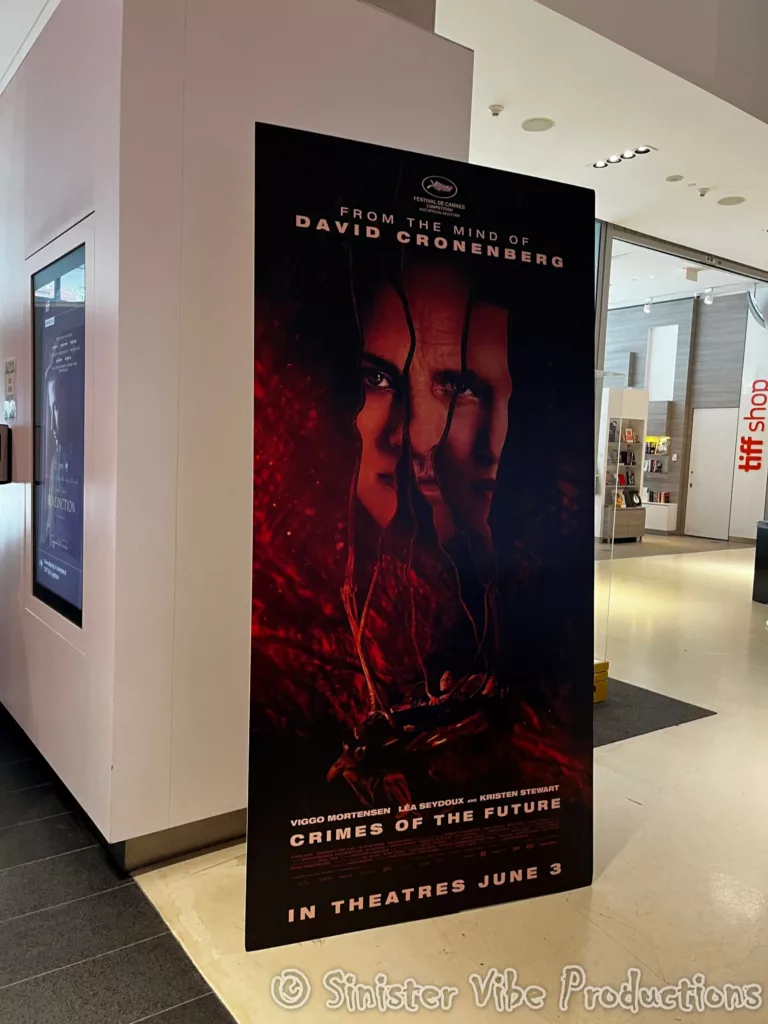
I’m so happy to be back at one of my favorite haunts, The TIFF Bell Lightbox.

It took a new David Cronenberg film and his return to what he does best, body horror. Crimes of the Future is not for the squeamish and bit too much for my wife.

It brought back a lot of Cronenberg themes from his films such as Crash, The Fly, Videodrome, Dead Ringers and eXistenZ. This film is a Cronenberg greatest hits package, and I loved every minute of it.

As I walked out of the theatre, I noticed display cases showing artifacts from all these films, so this perfectly curated the film today. I’m so happy to see Cronenberg back in the genre the created.