“A Trip to the Moon” (Le Voyage dans la Lune) is a French science-fiction film released in 1902 and created by Georges Méliès in Paris. It draws inspiration from Jules Verne’s 1865 novel From the Earth to the Moon.
This silent film, which runs for about fifteen minutes, depicts a journey to space launched by a giant cannon. Along the way, it features imaginative elements such as lunar beings known as Selenites and their ruler, oversized mushrooms, a view of Earth rising, a dramatic splashdown return, and a variety of Méliès’ signature visual effects.
The film stars Georges Méliès as the bearded Professor Barbenfouillis. Performers include dancers from the Théâtre du Châtelet as the cannon crew, cabaret artist Bleuette Bernon as Phoebe—the woman in the moon—and acrobats from the Folies Bergère portraying the Selenites.
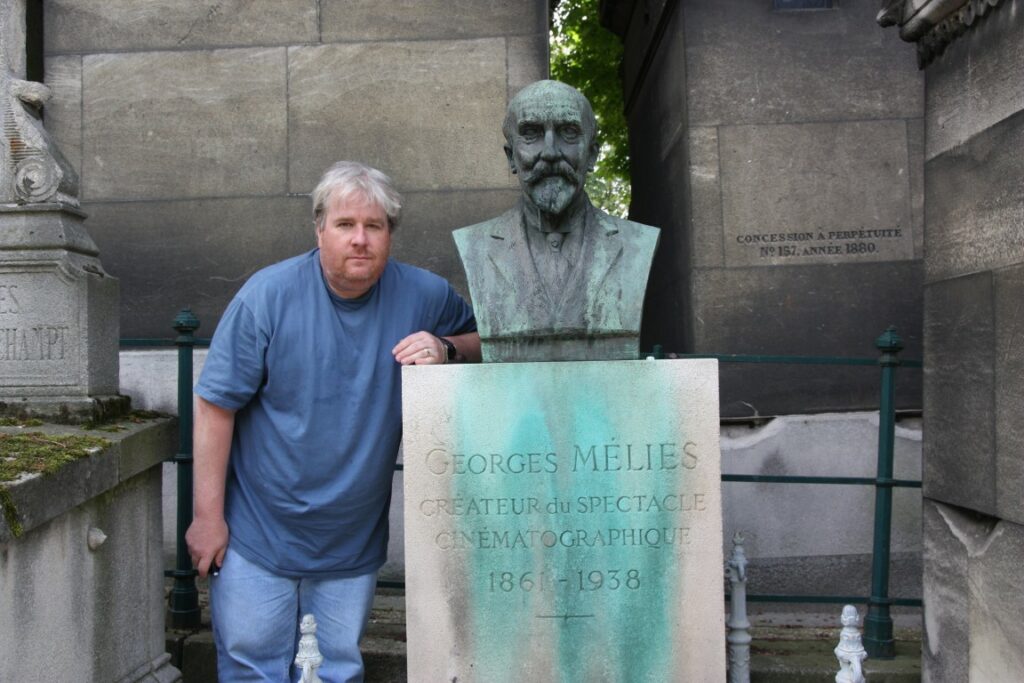
Georges Méliès (1861–1938) was a pioneering French filmmaker, illusionist, and one of the earliest visionaries of cinema. Originally trained as a stage magician and owner of the Théâtre Robert-Houdin in Paris, Méliès brought his passion for illusion and spectacle to the emerging medium of film in the late 19th century. After witnessing early motion pictures by the Lumière brothers, he quickly recognized film’s potential not just to capture reality, but to create fantastical worlds.
Méliès is best known for developing many of the first special effects techniques in cinema, including multiple exposures, stop-motion substitutions, dissolves, and hand-painted color. His films often featured imaginative narratives filled with magic, science fiction, and theatrical flair, setting them apart from the documentary-style films common at the time. His most famous work, A Trip to the Moon (1902), remains an iconic piece of early cinema, celebrated for its inventive storytelling and groundbreaking visual effects.
Over his career, Méliès directed and produced more than 500 films through his company, Star Film Company. However, as the film industry industrialized and shifted toward longer, more narrative-driven productions, his style fell out of favor. Financial difficulties eventually forced him to stop filmmaking, and many of his works were lost or destroyed.
Despite this decline, Méliès’ contributions were rediscovered and celebrated later in life. Today, he is regarded as one of the founding figures of narrative cinema and special effects, whose imaginative approach helped transform film into an art form capable of telling extraordinary stories.